AI took center stage at the #NVIDIAGTC keynote. Jensen Huang outlined the rise of AI factories, agentic AI systems, and physical AI powering robotics and industry—alongside the next generation of accelerated computing platforms and software to scale intelligence worldwide. https://t.co/c2xLIHS1Uj
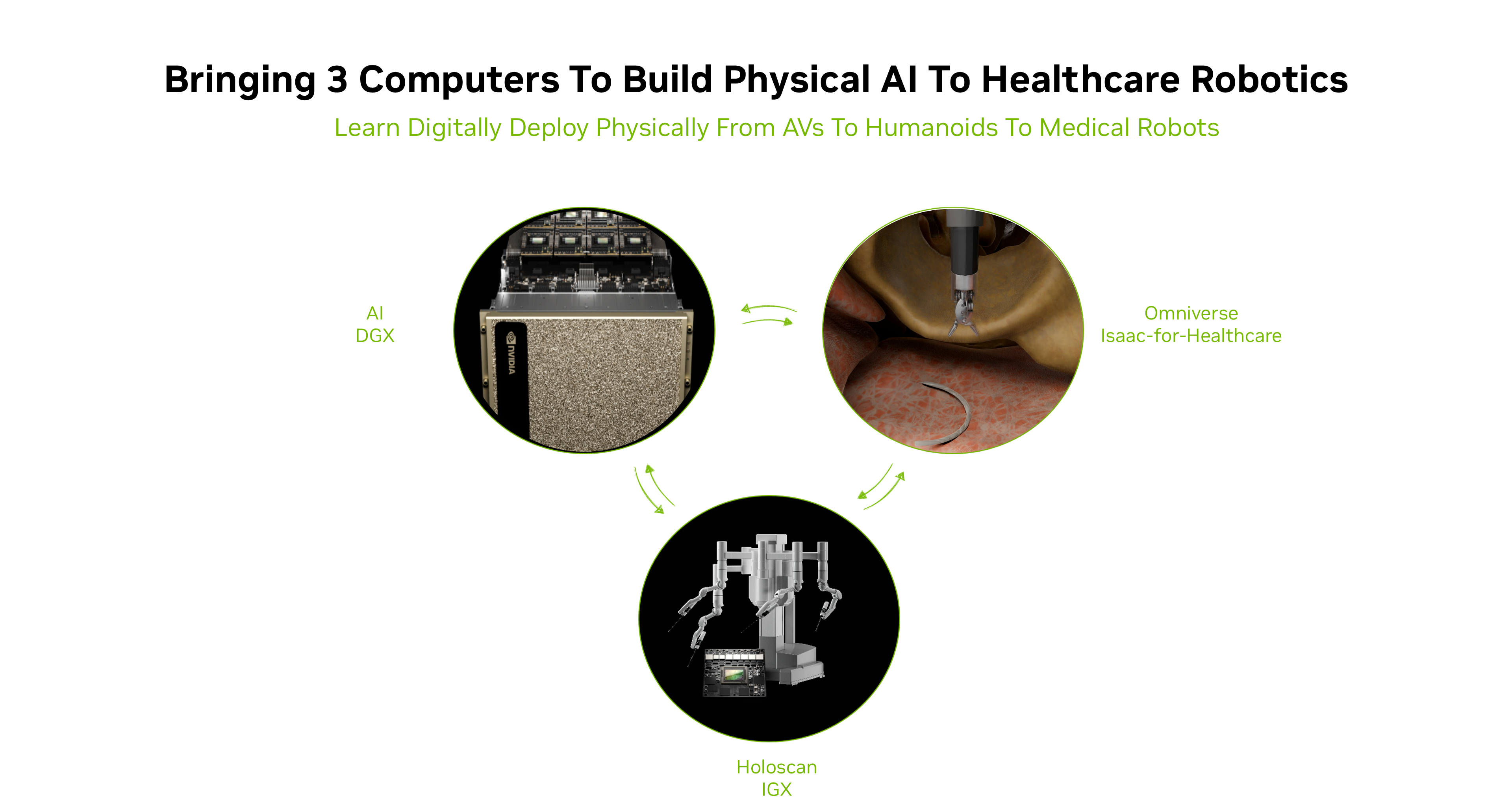
Infographic showing NVIDIA’s three‑computer framework for physical AI: DGX for model training, Omniverse/OVX for simulation and synthetic data, and Holoscan/IGX for real‑time on‑robot deployment. It directly illustrates the GTC keynote’s focus on “physical AI” powering robotics and industry and how AI factories operationalize intelligence from training to deployment.
Source: NVIDIA Technical Blog
Research Brief
What our analysis found
NVIDIA's GTC 2026 conference, held March 16–19 at the San Jose McEnery Convention Center, served as the launchpad for the company's most ambitious product cycle yet. During a two-hour keynote on March 16, CEO Jensen Huang laid out a sweeping vision for the next era of AI infrastructure, projecting at least $1 trillion in revenue from the Blackwell and Rubin chip families through 2027. The address covered three interlocking themes — AI factories, agentic AI systems, and physical AI for robotics — while unveiling a suite of new hardware and software designed to power them.
On the hardware front, NVIDIA detailed its Rubin platform, featuring rack-scale NVL72 and HGX NVL8 systems with end-to-end confidential computing spanning CPUs, GPUs, and NVLink interconnects, with CoreWeave slated as an early adopter in the second half of 2026. The company also revealed the 88-core Vera CPU, with racks housing up to 256 liquid-cooled Vera chips claiming up to a 6× gain in CPU throughput. Supporting the memory demands of next-generation models, partner Micron announced high-volume production of HBM4 for the Rubin platform during GTC week, citing 2.3× bandwidth improvement and roughly 20% better power efficiency.
For agentic and long-context AI workloads, NVIDIA launched BlueField-4 STX, a modular accelerated storage architecture built around the BlueField-4 DPU and ConnectX-9 SuperNIC, claiming up to a 5× boost in tokens per second and power efficiency for long-context inference. On the software and ecosystem side, NVIDIA highlighted its NIM microservices platform, with partners like Oracle exposing over 100 NIM models on its cloud. Physical AI ambitions were underscored by an expanded partnership with ABB to integrate Omniverse-powered simulation into industrial robotics via RobotStudio, building on NVIDIA's Isaac and GR00T robot foundation models.
Fact Check
Evidence from both sides
Supporting Evidence
Official keynote themes match the tweet's claims
NVIDIA's own GTC 2026 press release explicitly listed AI factories, agentic systems, and physical AI as the central keynote themes, directly corroborating the tweet's characterization of the address (nvidianews.nvidia.com).
Rubin platform confirms next-gen accelerated computing
NVIDIA's investor press release detailed the Rubin generation with rack-scale NVL72 and HGX NVL8 systems, six new chips, and confidential computing at scale — substantiating the tweet's reference to next-generation computing platforms (investor.nvidia.com).
BlueField-4 STX targets agentic AI infrastructure
Announced at GTC 2026, BlueField-4 STX is specifically engineered to resolve data-path bottlenecks in agentic and long-context AI workloads, with NVIDIA claiming up to 5× improvement in tokens per second and power efficiency (tomshardware.com).
Vera CPU expands the AI factory hardware stack
The unveiling of the 88-core Vera CPU and 256-chip liquid-cooled racks demonstrates NVIDIA's push to own more of the full data center stack — CPUs alongside GPUs, DPUs, and SuperNICs — reinforcing the AI factory narrative (tomshardware.com).
Physical AI and robotics partnerships are active
ABB and NVIDIA's collaboration on Omniverse-powered RobotStudio libraries for industrial-grade physical AI, along with continued development of Isaac and GR00T foundation models, supports the tweet's claim about physical AI powering robotics and industry (blogs.nvidia.com).
Software ecosystem scales globally through cloud partners
Oracle Cloud Infrastructure making over 160 AI tools and 100+ NVIDIA NIM microservices available to enterprises supports the tweet's assertion that NVIDIA is deploying software to scale intelligence worldwide (nvidianews.nvidia.com).
Live press coverage confirms keynote framing
Independent reporting from outlets including TechRadar and Axios corroborated the AI factory and agentic AI framing, as well as Huang's $1 trillion revenue projection through 2027 (techradar.com, axios.com).
Contradicting Evidence
Rising competition from hyperscaler custom chips
The Associated Press notes that NVIDIA faces growing competitive pressure from in-house AI chip programs at Google, Meta, and other major cloud providers, a dynamic that could temper the dominance implied by the keynote's sweeping vision (apnews.com).
Revenue projections are forward-looking and unverified
Huang's claim of at least $1 trillion in revenue from Blackwell and Rubin chips through 2027 is a projection, not a confirmed figure, and depends on sustained enterprise demand and supply chain execution that remain uncertain.
Many announced products are pre-deployment
Several headline announcements — including the Rubin platform, Vera CPU racks, and BlueField-4 STX — are not yet in broad commercial availability; CoreWeave adoption is not expected until the second half of 2026, meaning real-world performance and adoption remain to be proven.
Performance claims lack independent benchmarks
NVIDIA's stated gains — such as the 5× improvement in tokens per second from BlueField-4 STX and the 6× CPU throughput from Vera racks — are company-sourced figures that have not yet been independently verified by third-party reviewers.
Agentic AI is still an emerging category
While NVIDIA is investing heavily in agentic AI tooling and infrastructure, the technology is still in early enterprise adoption phases, and broad, scaled deployment of autonomous AI agents across industries has yet to materialize at the level the keynote messaging suggests.
Report an Issue
Found something wrong with this article? Let us know and we'll look into it.